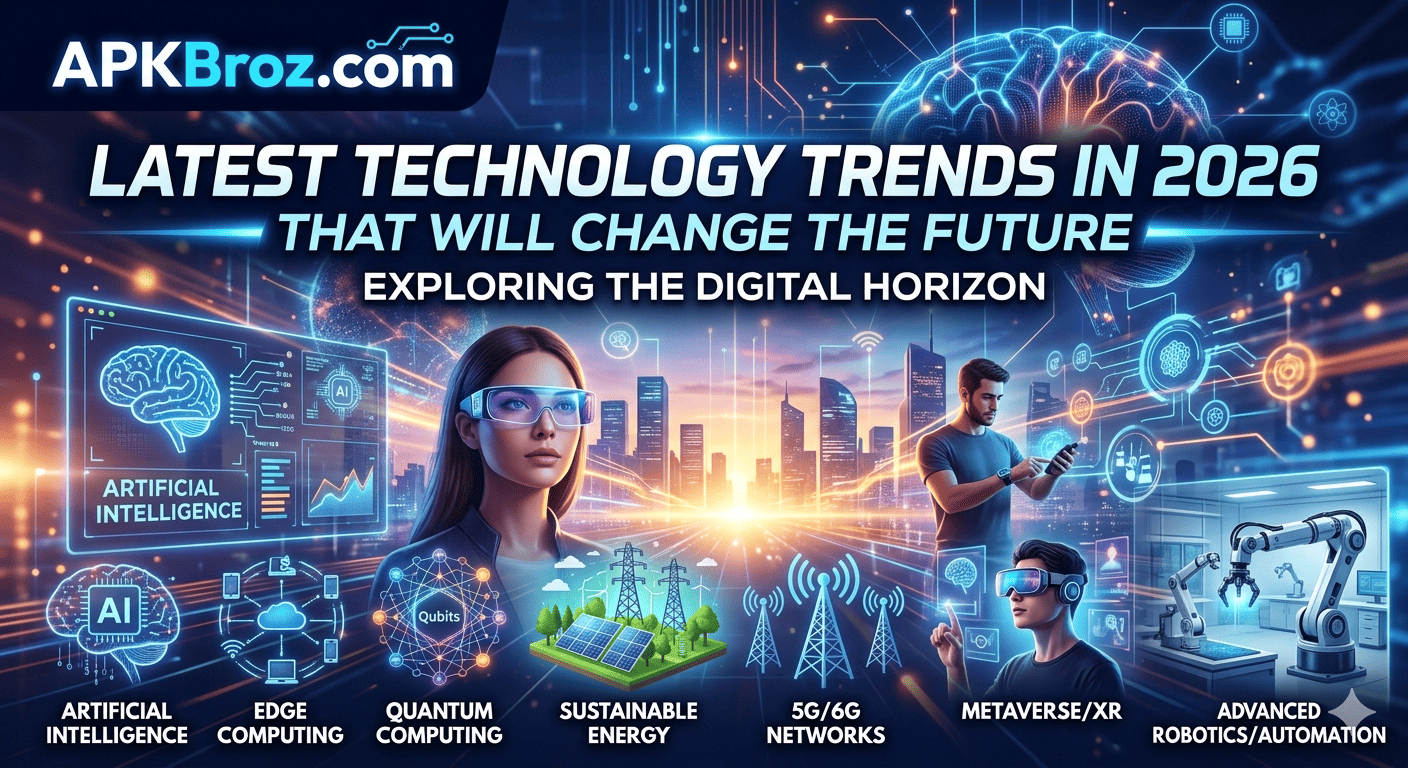
Technology is evolving faster than ever, and 2026 is shaping up to be a revolutionary year for innovation. From advanced artificial intelligence to quantum computing and immersive digital experiences, these technologies are transforming how people work, communicate, and live. Businesses, governments, and individuals are rapidly adopting new technologies that will redefine industries and create opportunities for the future.
In this article, we explore the latest technology trends in 2026 that will change the future and how they are expected to impact society.
1. Artificial Intelligence Everywhere
Artificial Intelligence (AI) remains the most powerful technology trend in 2026. AI is now deeply integrated into daily life, powering smart assistants, business automation, cybersecurity systems, and healthcare diagnostics. Many companies are investing heavily in AI because it improves productivity and decision-making across industries.
Modern AI systems are becoming more advanced with multimodal capabilities, meaning they can understand text, images, video, and audio simultaneously. These AI systems help automate tasks such as content creation, customer support, and data analysis.
In the future, AI will become a core infrastructure technology, similar to the internet or electricity.
2. Physical AI and Smart Robotics
Robotics combined with AI—often called physical AI—is rapidly expanding in industries such as manufacturing, logistics, healthcare, and agriculture. Companies are developing intelligent robots capable of learning tasks in simulated environments and performing them in real life.
These robots can perform repetitive or dangerous tasks, helping businesses increase efficiency while reducing costs. The robotics market is expected to grow significantly over the next decade as automation becomes essential for global industries.
In the future, autonomous robots could work alongside humans in factories, warehouses, hospitals, and even homes.
3. Quantum Computing Breakthroughs
Quantum computing is another major technology trend that could revolutionize problem-solving. Unlike traditional computers, quantum computers can process complex calculations simultaneously, making them extremely powerful for scientific simulations and data analysis.
Industries such as pharmaceuticals, finance, and climate research are exploring quantum computing to solve problems that traditional computers cannot handle efficiently.
Although fully scalable quantum computers are still developing, 2026 marks an important step toward hybrid quantum-classical computing systems.
4. Edge AI and Smart Devices
Edge AI refers to artificial intelligence that runs directly on devices rather than relying entirely on cloud servers. Smartphones, IoT devices, smart cameras, and wearables are increasingly using on-device AI processing.
This technology offers several advantages:
- Faster processing speed
- Better data privacy
- Reduced internet dependency
- Real-time decision making
Edge AI will play a major role in smart homes, autonomous vehicles, and industrial automation.
5. 6G and Next-Generation Connectivity
While many regions are still expanding 5G networks, researchers and technology companies are already working on 6G wireless technology. Early tests of 6G networks are expected to begin around 2026.
6G could offer:
- Speeds up to 1 terabyte per second
- Ultra-low latency communication
- Real-time holographic calls
- Advanced smart cities infrastructure
These improvements will enable futuristic applications like remote surgery, autonomous transport systems, and immersive virtual worlds.
6. Extended Reality (XR) and Virtual Workspaces
Extended Reality (XR), which includes Virtual Reality (VR), Augmented Reality (AR), and Mixed Reality (MR), is transforming how people work and interact digitally. XR technologies are being used for remote collaboration, education, gaming, and training.
Companies are developing virtual offices and digital workplaces where employees can collaborate in immersive environments. This technology could redefine remote work and digital communication.
7. Digital Twins and Smart Infrastructure
Digital twin technology creates virtual replicas of physical objects, systems, or cities. These digital models allow organizations to simulate real-world scenarios and predict problems before they occur.
When combined with AI, digital twins help businesses optimize manufacturing, improve energy efficiency, and monitor complex infrastructure systems.
In the future, digital twins could be used to manage smart cities, transportation networks, and large industrial systems.
Conclusion
The technology landscape in 2026 is driven by rapid innovation and integration of advanced systems. Technologies like AI, robotics, quantum computing, edge AI, and 6G networks are not only improving existing industries but also creating entirely new possibilities for the future.
Businesses that adapt to these trends early will gain a competitive advantage, while individuals who develop digital and technical skills will be better prepared for the future workforce.
As these technologies continue to evolve, they will reshape the global economy, redefine human interaction with machines, and unlock opportunities that once seemed impossible.